Updates
New Room Block Sep 24, 2026
Great news! We've secured a new room block for ASSETS attendees at the Tivoli Kopke Porto Gaia Hotel!
The Tivoli Kopke is conveniently located just 80 metres (about 260 feet) from the conference venue at the Hilton Porto-Gaia; though be aware the route is downhill and can be quite steep. The special room rates are similar to those offered in our original room block.
To reserve your room, visit the Tivoli Kopke Porto Gaia booking page and use the promo code NHTKPGCOG.
Availability is limited, so we encourage you to book soon.
ASSETS Room Block Is Sold Out! Sep 14, 2026
We're delighted (and a little overwhelmed) by the incredible response from the ASSETS community. The conference room block at the Hilton Porto-Gaia is now fully booked, which means the ASSETS special hotel rates are no longer available.
How was the room block cap determined?
The size of the room block was determined using historical reservation data. This year's demand has exceeded expectations, an exciting sign that this is shaping up to be the largest ASSETS conference yet.
What now?
The organising committee is working hard to identify nearby hotels that can offer special rates to ASSETS attendees. We'll share further accommodation options as soon as possible.
Can you still register and attend ASSETS?
Conference registration is still open, and a few places are available, but they are filling up quickly. Attendance is limited by the seating capacity at the Hilton Porto-Gaia and by the physical spaces in and around the conference area. If you are planning to join us in person, we encourage you to register soon.
ASSETS 2026 Workshops: Registration as an Add‑On to the Conference Experience May 27, 2026
Workshops are a highlight of ASSETS. These are interactive, community-driven spaces to explore emerging ideas in computing and accessibility. To ensure workshops are well supported and fully integrated into the conference, we're making an important change for ASSETS 2026.
The Decision (TL;DR)
- To attend any workshop, participants must be registered for the full ASSETS 2026 conference. Workshops will be offered as an add‑on, meaning an additional fee on top of the main (in-person or online) registration.
- Workshops are either run online or in-person (no hybrid format).
- Online workshops will cost half as much as in-person workshops.
- In-person workshops will include a free online workshop. Online workshops will be scheduled to happen before the main conference.
- We'll share final registration rates as soon as they are confirmed.
Why We're Doing This
We are centering the overall conference experience and long-term financial sustainability. Workshops create real value for the community, but they also require reliable infrastructure, staffing, and accessibility support, so we need a model that lets us plan and deliver them well.
Workshops are part of ASSETS, not a separate event.
Workshops should be embedded in the shared conference context to create common expectations for participation, consistent accessibility standards, and clear pathways for workshop outcomes to connect back to the main program. Requiring full registration helps maintain the "one conference community" feeling, so workshops contribute to ASSETS, rather than fragmenting it into separate audiences.
Workshops depend on conference infrastructure (and those costs do not scale down).
All workshops use conference-level systems and operations: submission/review tooling (PCS), registration and attendee management (Cvent), communications, scheduling, venue space, A/V, food & beverage (for in-person), and accessibility services. Stand-alone workshop registration makes it difficult to allocate these shared costs fairly and predictably. We are treating workshops as an add-on to full registration as a clearer way to match resources to demand and keep workshops properly supported.
This model protects quality, accessibility, and a good experience for everyone.
We want workshops to have appropriate staffing, clear logistics, and the accessibility services participants rely on. A stable registration structure helps us deliver on that experience while keeping the conference financially viable.
What This Means for Attendees
- If you want to attend a workshop, you'll need to register for the full conference.
- Workshops will have an additional add‑on fee.
- Workshops will be scheduled as either in-person or online (as determined by the organizers).
What This Means for Workshop Organizers
Organizers will also need a full conference registration. Workshop organizers should plan to register like all other attendees. To alleviate the financial costs for organizers, we will offer a free registration code.
Organizers will be asked to indicate their preferred workshop format (in-person or online). Final scheduling and format will be determined in coordination with the workshop chairs, based on conference logistics and program constraints. Online workshops will be scheduled to avoid typical travel times and to minimize conflict with the main conference program. In-person workshop capacity is limited, and we expect to offer either one full-day workshop or two half-day workshops on Sunday.
Registration will run through the main conference system. Workshop attendance will be purchased as an add‑on during ASSETS registration, and attendees will be managed through the same platform and communications channels as the main conference.
We believe this approach best supports workshops as a meaningful part of ASSETS: well-resourced, accessible, and connected to the broader conference community.
Review Process for Technical Papers Apr 28, 2026
Quick Links
- Process Overview
- Preparing to Review
- Assigning Reviewers
- Reviewing
- Discussion, Review Revision, & Final Decisions
- ASSETS 2026 Review Timeline
Process Overview
Technical Program Chairs (TPCs) recruited a Program Committee (PC) to complete all reviews. After (1) authors submit papers, (2) PC members (reviewers) will have an opportunity to report conflicts of interest and bid for papers that are aligned with their areas of expertise. At the same time, TPCs will take a first pass at identifying papers for early rejection without review. After bidding concludes, (3) TPCs will assign three knowledgeable PC members to review each paper, one of whom will be assigned a lead reviewer role. (4) PC members will take a second pass at identifying papers for early rejection and review remaining papers, as lead reviewers check for review quality. As reviewing concludes (5) lead reviewers and TPCs will check reviews for quality and send reviews to authors. (6) Authors may choose to submit a rebuttal. (7) Lead reviewers initiate discussion amongst reviewers, who then read other reviews, the rebuttal, and contribute to deliberation. PC members update reviews. Finally, (8) lead reviewers and TPCs check review quality, then TPCs finalize decisions and send notifications to authors.
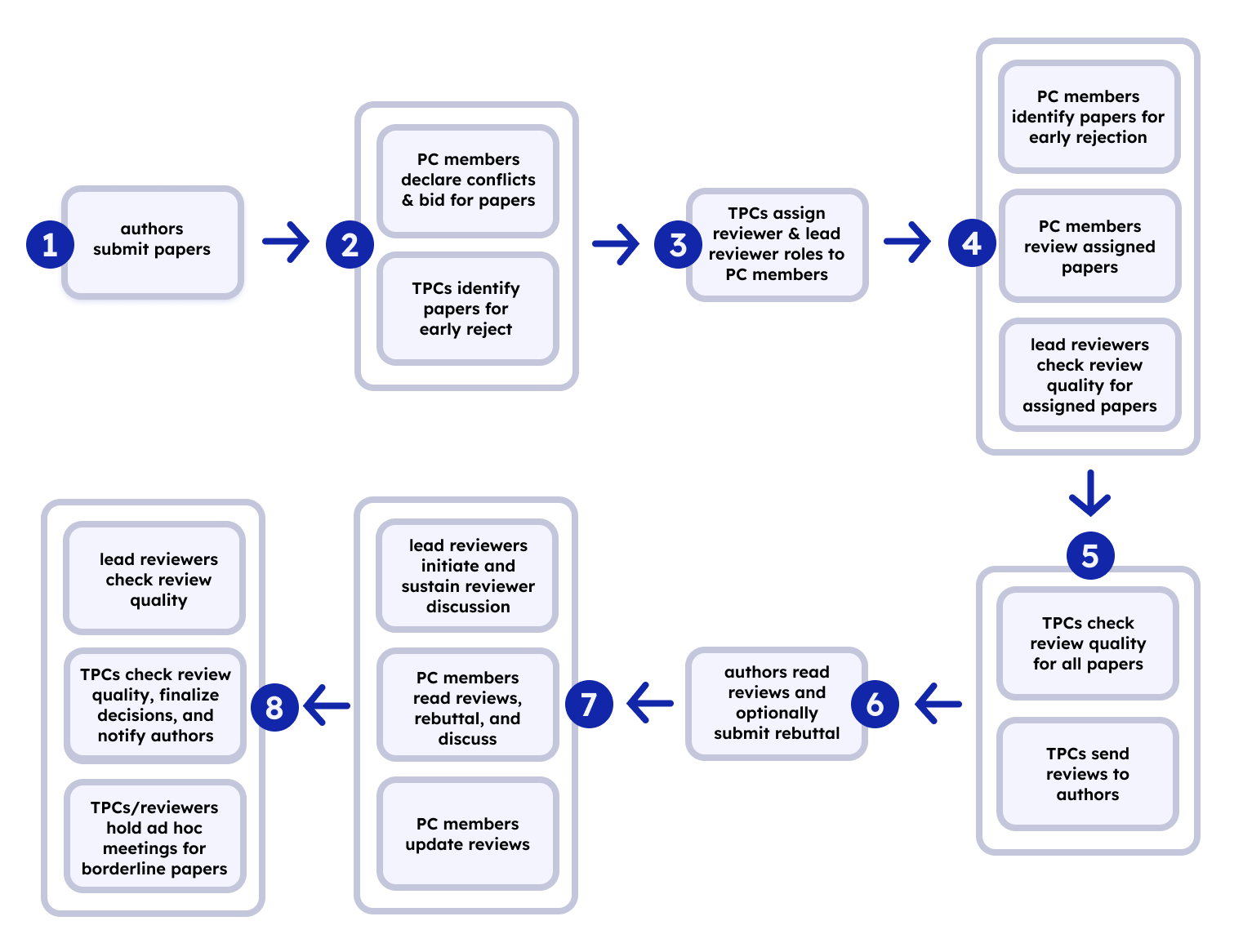
Preparing to Review (Phases 1 and 2)
Before the technical paper deadline, PC members will update their profile in the Precision Conference (PCS) system with their latest areas of expertise, publication samples, and conflicts of interest. They will also indicate the maximum number of reviews they volunteer to complete.
After the technical paper deadline, PC members will be invited to read all submission titles and abstracts, identifying additional conflicts of interest and "bidding" on which papers are most aligned with their expertise.
TPCs will split paper submissions amongst themselves, avoiding conflicts of interest. For each paper, the TPC will check early rejection criteria. Submissions that do not meet formatting or accessibility guidelines, are not properly anonymized, are out of the topical scope of the conference, or are otherwise deemed non-competitive by the program chairs will be rejected without review.
Assigning Reviewers (Phase 3)
Next, the TPC will assign three reviewers to each paper based on the PC member bidding results, PCS automated recommendations, and reviewers' self-reported areas of expertise. TPCs may invite additional members to the PC at this time, if there is inadequate expertise or capacity on the existing PC. Finally, one of the three reviewers will be selected to serve as the lead reviewer for each paper. TPCs will release review assignments to PC members. The ASSETS review process is double anonymous, meaning that authors will not see the identity of reviewers, reviewers will not see the identity of authors, and, in turn, reviewers will not see the identity of other reviewers.
Reviewing (Phases 4 and 5)
Please note that reviewers are responsible for complying with the ACM Peer Review Policy. At this stage, reviewers will read submissions and flag additional early rejection candidates. Again, these are submissions that do not meet formatting or accessibility guidelines, are not properly anonymized, are out of the topical scope of the conference, or are otherwise deemed non-competitive. The TPCs will finalize early rejections flagged by reviewers in this phase.
Reviewers will then provide a comprehensive review of the submission according to the following four criteria:
- Appropriateness. Does this paper fit in ASSETS? The ASSETS conference explores the design, evaluation, and use of computing and information technologies to benefit people with disabilities and older adults. ASSETS is the premier forum for presenting innovative research on mainstream and specialized assistive technologies, accessible computing, and assistive applications of computer, network, and information technologies. For more information, please see the ASSETS 2026 Call for Papers. There is not always consensus about what is an ASSETS paper. Even if you have concerns about the scope, please explain your concerns AND still provide a full review as your comments will be valuable for the discussion and decision-making process.
- Originality / Significance. How significant is the work described? Does it represent an original contribution to the state of the art? If the ideas are novel, will they also be useful or inspirational? If the results are sound, are they also important? Could the results make a difference in the lives of people with disabilities or older adults?
- Soundness / Correctness. Is the technical approach sound and well-chosen? Can one trust the claims of the paper — are they supported by proper background and proper evaluation (with the target users, when appropriate)?
- Clarity. For the reasonably well-prepared reader, is it clear what was done and why? Is the paper well-written and well-structured? Do the English, math, figures or tables need cleaning up? Is there sufficient detail for an expert to validate the work, i.e., by replicating experiments or following procedural or theoretical steps?
There will be opportunities for reviewers to flag potential violations of the ACM Policy on Authorship, as well as nominate candidates for awards or special recognition. Reviewers will have an opportunity to raise concerns about missing, insufficient, or inappropriate reviews. TPCs will address review quality concerns by following up with assigned reviewers and, where appropriate, appointing substitute or additional reviewers. When reviews are complete, TPCs will release reviews to authors.
Discussion, Review Revision, & Final Decisions (Phases 7 and 8)
During this phase, the lead reviewer will initiate discussion amongst reviewers for each paper in PCS. Reviewers will read each others' reviews, read the authors' rebuttal (if submitted), and discuss how these perspectives might change their assessment of the paper. Lead reviewers will seed conversation around shared and divergent perspectives, toward convergence on a decision or explicit awareness of convergence. After deliberation, reviewers will update the body of their review to reflect the additional deliberation, potentially updating their scores.
Lead reviewers and TPCs will check all reviews for completion and quality. For borderline papers, TPCs may invite reviewers to a synchronous meeting for further discussion. TPCs will convene to make final acceptance and rejection decisions. Authors will be notified.
ASSETS 2026 Review Timeline
You can access this timeline via our PC Google Calendar, which has reviewing details in the event descriptions.
| Phase | Date(s) | Reviewing Activity |
|---|---|---|
| 1 | April 22 | Authors: Technical Paper Submission |
| 2 | April 23 to April 27 | PC: bid on papers TPC: flag early rejects |
| 3 | May 4 | TPC: assign reviewer and lead reviewer roles |
| 4 | May 4 to May 27 | PC: flag early rejects PC: complete reviews PC, lead reviewer: check review quality |
| 5 | June 3 | TPC: check review quality and send reviews to authors |
| 6 | June 10 | Authors: optionally submit rebuttal |
| 7 | June 11 to June 17 | PC, lead reviewers: initiate and sustain discussion PC: read reviews, rebuttal, and discuss PC: update reviews |
| 8 | June 18 to June 19 | TPC/PC: ad hoc meetings to discuss borderline papers |
Questions or comments? Please email the TPCs at tpc-assets26@acm.org.
New at ASSETS 2026: Recognizing Social Impact Mar 27, 2026
The Recognition for Contribution to Social Impact at ASSETS highlights strong examples of community-driven work that present groundbreaking insights into pressing social issues and/or have the potential to result in structural, long-term positive social change.
Reviewers will be invited to nominate papers for this Recognition, and the final selection will be made by a committee.
Recipients will be honored at the closing plenary with a certificate presented by the Technical Program Chairs.
Please note: this is an ASSETS 2026 recognition, not an ACM-level award.
ASSETS POLICY ON PROGRAM COMMITTEES Feb 27, 2026
Program Committee Members
The Program Committee is responsible for objectively and thoroughly reviewing all submissions, and for submitting timely, informative reviews that provide authors with feedback about their submissions.
The Program Committee members should be recognized experts in the subject area of the event. All Program Committee members should possess a Ph.D. In rare cases, doctoral candidates with a proven track record of publication in the field may be invited to serve on the Program Committee. For recurring events, the committee should not have a fixed membership, but rather be constituted each year to fit the changing needs of the conference.
Reviewing Submissions
Submissions should be reviewed by the Program Committee members themselves, rather than by their chosen delegates. Program Committee members are encouraged to seek advice from external reviewers if needed, but they are still responsible for having reviewed the submission themselves. Each submission should be reviewed by at least three Program Committee members.
Submissions from Organizing Committee Members
Please consult the ACM SIGACCESS Conflict of Interest Policy for how conflicts of interest will be managed across activities related to the SIG. For the ASSETS conference, the following protocol has been established to comply with this policy: If the General Chair or Program Chair wishes to submit a Technical Paper (as either a sole or co-author) to the conference, then a Deputy Program Chair must be appointed. The Deputy Chair’s role is to appoint reviewers to these submissions using the regular conference mechanism, and appoint a third party, whose identity is unknown to the submitting author, to oversee the decision for that submission. This anonymity will enable an independent decision to be made about the paper.
This anonymous third party will determine an overall score or ranking for the submission. To preserve the anonymity of the third party and reviewers, the decision process for such submissions will be conducted “offline” from the regular website if necessary. After the Program Chair has made initial accept/reject determinations for the other papers, if the Deputy Chair determines that the submitted paper from the General Chair or Program Chair is not a clear accept or reject, then the third party will also be responsible for the final accept/reject decision on this paper.
A similar process can be employed by the chair of other conference activities (such as Posters and Demonstrations), if they wish to submit a paper to that activity. All other members of conference committees may submit to all activities. Care must be taken that these submissions are reviewed at least as stringently as other submissions, in keeping with the ACM SIGACCESS Conflict of Interest Policy .
Conflicts of Interest and Confidentiality of Submissions
ASSETS requires members of the Program Committee to adhere to the highest of ethical standards. These standards are outlined in the ACM SIGACCESS Conflict of Interest Policy . Program Committee chairs must ensure that these standards are not only met to the letter of the policy but also to the spirit of its intent. This means that even the appearance of a conflict of interest or breach of confidentiality in the selection process should be avoided.
A Program Committee member (including the chair of the committee) is considered to have a conflict of interest on a submission on which they are an author or that has an author in any of the categories identified by the ACM SIGACCESS Conflict of Interest Policy .
Committee members must declare their conflicts to the program chair before any reviews of the submissions begin.
Committee members in conflict with an author will not be allowed to see the reviews of the submission, nor will the names of the reviewers be divulged. During any and all discussions of the submission (written or verbal), the member in conflict will be barred from participating in any way either actively or passively (e.g., by absenting themselves from the room in which the discussion is being held, not being a recipient of email, etc.).
In case the program chair is in conflict, the chair will assign an alternate chair for any submissions for which they have a conflict. This alternate chair should be a member of the Program Committee who does not have a conflict. For those submissions, the alternate chair will select the reviewers and will conduct the reviews and any discussion without revealing the identities of the reviewers to the Program Committee Chair.
Submissions themselves and discussions conducted by a Program Committee during the selection process are considered to be confidential.
This conflict of interest and confidentiality policy extends to any supplemental reviewers outside of the immediate Program Committee, if such reviewers are permitted by the procedures of the committee. The committee member seeking the supplemental review is responsible for ensuring the enforcement of the policy.
The Program Chair will make reasonable efforts to ensure that the manuscripts submitted are made available to and reviewed only by the Program Committee and supplemental reviewers acting on behalf of the Program Committee. Neither ASSETS nor ACM guarantee the confidentiality of the submitted manuscripts, and accept no liability in the event that the manuscripts are distributed beyond the reviewers.
Awards and Special Issues of Journals
By default, the PC Chair is the selection committee chair for awards and special issues of journals. The Chair, however, may transfer the job of selection committee chair over to someone selected by the SIGACCESS EC if they so choose. If the PC Chair is in conflict with papers under consideration, the PC Chair cannot act as the selection committee chair and must request the SIGACCESS EC to appoint an alternate. The selection committee chairs may appoint additional committee members if they so choose.
Exclusions to avoid conflict of interest:
- Papers co-authored by members of the selection committee are not eligible.
- Papers in conflict with the selection committee chair(s) are not eligible.
Calls for Submissions/Participation
Conferences should require full-length, original papers for review. The conference website for the Calls for papers should reference the ASSETS Program Committee Conflict of Interest Policy. It should also include explicit prohibitions against the submission of papers that have been previously published or are being submitted elsewhere.
All Calls should make authors aware of the ACM Policy and Procedures on Plagiarism . Authors must be asked to indicate their understanding and acceptance of the policy and procedures at the time of submission. This can normally be done as part of the electronic submission process, such as through a checkbox that must be checked in order for the submission to be recorded.
Policy approved by ASSETS Conference Steering Committee July 27, 2009. Modified February 27, 2026.